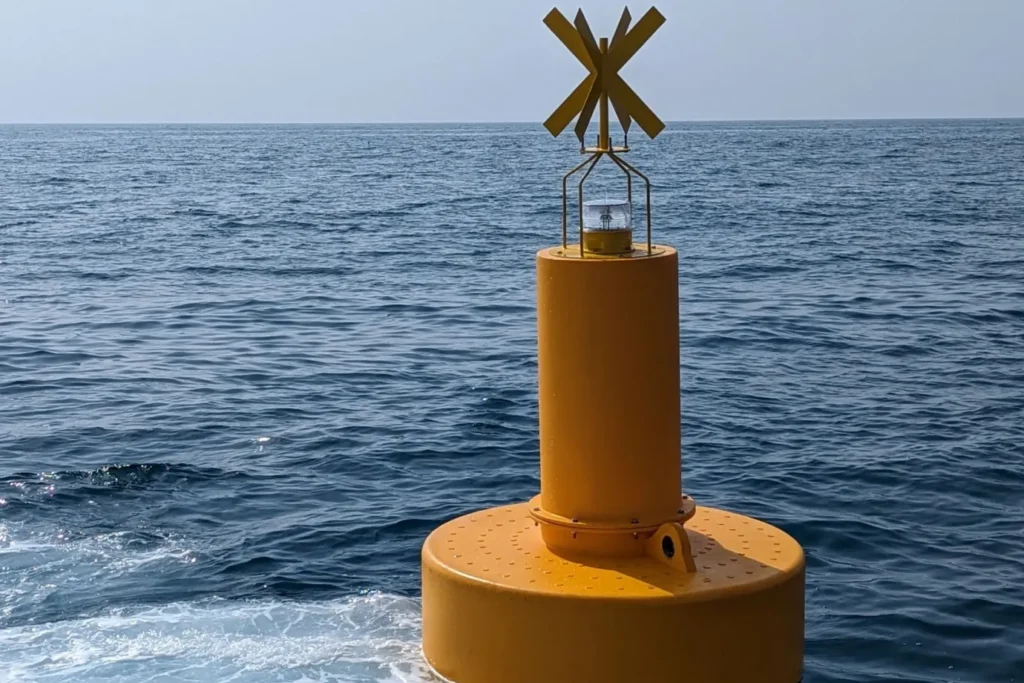

Navigation buoys are one of the most necessary Aids to Navigation (AtoN) tools worldwide. They clarify the safe navigation routes, port and starboard directions, marking hazards, and so on. Due to their critical role in providing safe navigation, it is crucial for them to be equipped with lights and marine lanterns to ensure high visibility even in night or extreme weather conditions, such as storms and fog, where visibility is significantly reduced. These navigation buoy lights typically guide navigators through specific flashing patterns following the International Association of Marine Aids to Navigation and Lighthouse Authorities (IALA) standards. Here we will understand what the most common buoy light flashing patterns are, what each flashing pattern means, and how they can signal navigators.
What Are Navigation Buoy Lights?
Navigation buoy lights are the most critical components of marine buoys, particularly in low-visibility conditions, such as nights, fogs, storms, etc. These lights are typically designed as compact marine lanterns installed on top of the buoy. They are equipped with one or multiple LED lights inside sealed, water-resistant lenses to be efficient in moisture environments and extreme weather conditions. The advanced marine lanterns are solar powered with a high-capacity battery to operate continuously for a long time.
The Importance of Using Navigation Buoy Lights

Marine buoys play critical role in ensuring safe navigation by indicating the right directions, safe routes, specifying the ports and starboard sides, and marking the hazardous areas, activities, and objects that require more caution. Navigations buoy is typically designed with strong highly visible colors, warning signs, and top marks to increase their visibility. At night or in conditions where the visibility is significantly reduced or limited, however, the navigation buoys are not recognizable. Therefore, it is crucial to use the marine lanterns to ensure safe navigation even at low-visibility conditions.
Common Types of Buoy Light Flashing Patterns
Buoy light flashing patterns are defined based on International Association of Marine Aids to Navigation and Lighthouse Authorities (IALA) standards for region A (Africa, Asia, Australia, and Europe) and region B (Americas, Japan, South Korea, and Philippines). For example, red and green buoys deliver different meanings in IALA region A and B. However, not all the buoys follow the same flashing pattern as signal mariners. Depending on its type and purpose of use, the buoy light patterns differ. Here are the most common flashing patterns for navigation of buoy lights:
| Abbreviation | Pattern | Meaning |
| F | Fixed | Navigational Distinction |
| FI | Flashing | Lateral or Channel Marks |
| LFI | Long Flashing | Major Navigation Routes & Harbour Entrance |
| Q | Quick Flashing | Cardinal Marks, Hazard Warnings & High-Priority Navigation Aids |
| VQ | Very Quick Flashing | Cardinal Marks & High Visibility in Areas with Lighting Background |
| Iso | Isophase | Safe Marks |
| Oc | Occulting | Lighthouses, Bridges & Coastal Navigation Aids |
| Mo | Morse Code | Safe Marks, Special Navigation Aids & Landmark Identification |
Fixed lights refer to the continuous illumination without any interruption. Flashing patterns refer to a cycle of light and darkness: flashing includes one short flash per cycle, long flashing includes one long flash per cycle, quick flash includes rapid flashes per minute, and very quick flashes include more flashes than quick flashes per minute. For instance, flashing is just one flash every 5 seconds, long flashing is a 3-seconds-flash per cycle, quick flash is about 50 to 70 rapid flashes per minute, and very quick flash is more than 80 rapid flashes per minute.
Isophase is a pattern where the light period is long as the darkness period. For example, if the light is 2 seconds, the darkness is also long as 2 seconds. Occulting refers to longer light and shorter darkness. Morse code flashing is a sequence of lights and darknesses based on morse code letters.
Buoy Light Flashing Patterns for Cardinal Buoys

Cardinal buoys indicate the directions of North, South, East, and West. The buoy light flashing patterns for North direction are quick flashing or very quick flashing. South direction, however, is indicated by a cycle of 6 quick flashing and a long flashing. Buoy light patterns for East direction are 3 quick flashing or 3 very quick flashing while for west direction, it is 9 quick flashing or 9 very quick flashing. Actually, the buoy light flashing patterns for directions mostly looks like a clock pattern: if we consider the 4 main directions as a clock, North is 12, East is 3, South is 6, and West is 9. The patterns of these navigation buoy lights are just like these numbers. In other words, North is indicated with continuous rapid flashes, East is indicated with 3 quick flashes, South is indicated with 6 quick flashes, and West is indicated with 9 quick flashes.
What Do Flashing Buoy Lights Mean with Different Colors?
The color of buoy light patterns widely depends on the buoy’s type and application. The lateral buoys are typically designed with red and green marine lanterns on top based on the IALA standards. In region A, the port mark lights are red, and starboard mark lights are green while in region B, the port mark lights are green, and the starboard mark lights are red. Cardinal, isolated, and safe water buoys are typically equipped with white color lights. But yellow lights are reserved for which class of buoy? Cautionary buoys or those with hazard mark purposes are often designed with yellow marine lanterns because yellow is often the sign of danger. Emergency wreck buoys, on the other hand, have blue and yellow lights.
Advanced Technologies in Buoy Light Patterns

Today, navigation buoy lights are engineered with cutting edge technologies to ensure maximum efficiency due to their critical role in providing safe navigation. Advanced marine lanterns are typically equipped with solar panels as their power source and a high-capacity battery inside to operate for long term. Moreover, the marine lanterns often include GPS to be tracked more easily when they are missed or dispositioned. They can also be designed totally remote-controlled, allowing for changing the buoy light flashing patterns or colors remotely.
Conclusion
Buoy light flashing patterns deliver different meanings in navigation world. They actually act as the most efficient and critical guidance for mariners at conditions where the visibility is significantly reduced, including night and extreme weather conditions such as fog and storm. The type of navigation buoys and their application affect the marine lanterns pattern and color. Therefore, understanding the buoy light patterns beside their types can help to navigate safe and sound. In this blog post, we learned what do flashing buoy lights mean and how to identify them properly.
FAQs
Depending on the buoy’s type, the buoy light patterns may be different in IALA region A and B. For example, red and green buoys deliver totally reversed meanings in region A and B and their flashing colors, too.
Permanent yellow buoys are charted, but the temporary ones used to mark construction, dredging, and research activities are mostly not.
It widely depends on the buoy’s design and marine lantern’s characteristics. However, navigation buoy lights should be identified from long distances to ensure maximum efficiency.